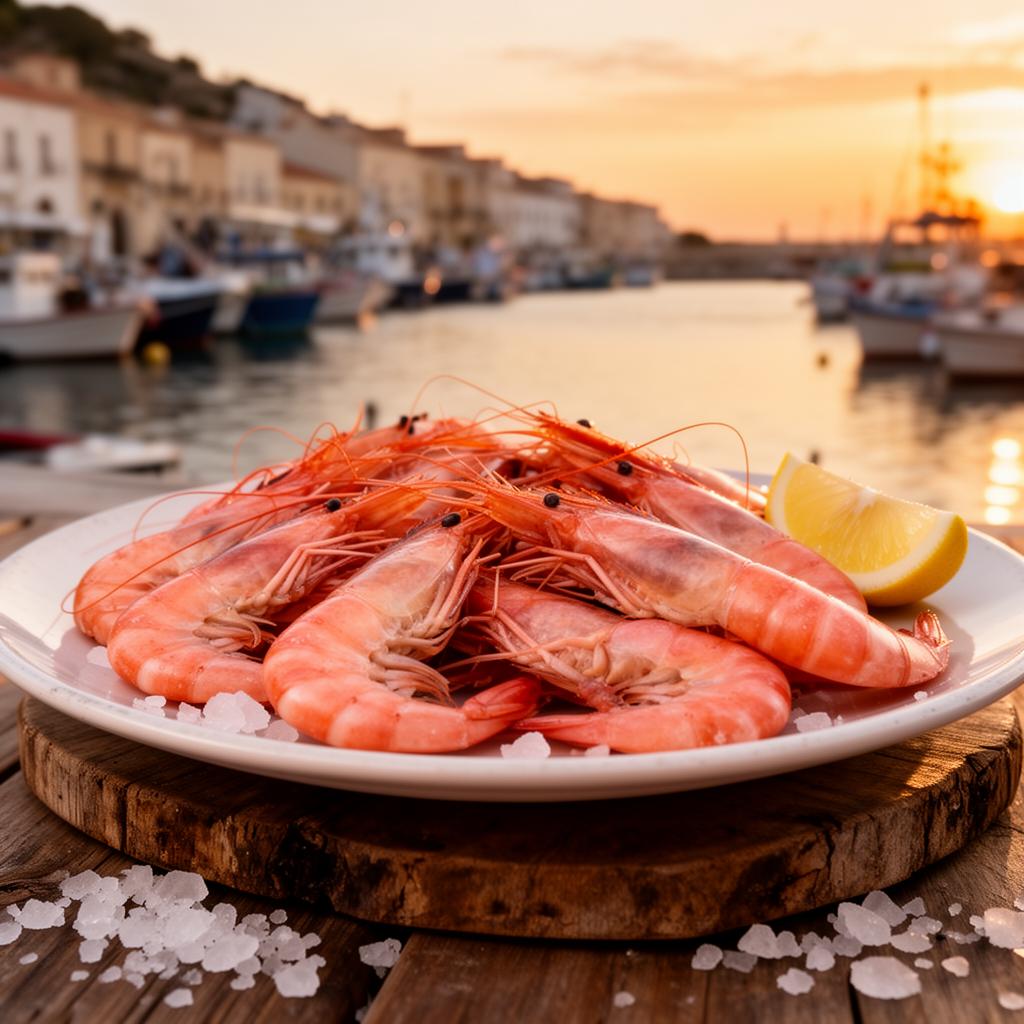
Motril Shrimp: The Most Complete Guide to the Queen of the Alboran Sea

All about Motril shrimp: origin, season, auction prices, where to eat it, 7 essential recipes, and why it's the most exclusive seafood in the Mediterranean. The definitive guide 2026.
There are flavors that are capable of capturing the essence of a place. Aromas that instantly transport us to a fish market at sunset, to the sound of waves breaking on the shore, to the feel of salt on the skin. The Motril shrimp is, without a doubt, one of those flavors. This small crustacean with a translucent body and almost unreal cobalt blue roe has earned its title as a gastronomic jewel of the Mediterranean, a treasure that transcends the culinary to become the soul and pride of the Costa Tropical of Granada.
Fished in the abysses of the enigmatic Alboran Sea, auctioned every afternoon in a frantic dance of prices and bids at the Motril fish market, and revered in the kitchens of the country's most prestigious chefs, the shrimp is much more than a simple seafood. It is the livelihood of entire families of fishermen, the economic engine of a historic port, and the reason why gourmets from all over the world set their sights on this corner of southern Spain. It is Motril's "darling," and in every bite, you can taste the respect for the sea, tradition, and the tireless pursuit of excellence.
In this definitive guide, the most complete you will find, we are going to reveal each and every one of its secrets. From its scientific name to the legends circulating in the fish market, from the mysterious underwater mountains where it lives to the infallible trick to know if it is fresh. We will teach you how to cook it like an authentic Motril native, we will tell you where to eat it when you visit us in [INTERNAL LINK: our apartments in Playa Granada → /apartamentos-playa-granada/] and we will explain why its price can exceed that of the most exclusive meats. Get ready for a journey into the depths of flavor. The queen of the sea is waiting for you.
What exactly is Motril shrimp?
When we talk about Motril shrimp, we are not referring to just any shrimp. We are talking about a specific species, with a unique DNA and organoleptic characteristics that make it unmistakable. Let's delve into its biological ID to understand why it is so special.
Scientific name and taxonomic classification
Under its popular name hides the Plesionika narval (Fabricius, 1787), a fascinating crustacean belonging to the class Malacostraca, the order Decapoda (ten legs) and the family Pandalidae. It is important to note that, in some older scientific studies, it can be found referenced as Plesionika edwardsii (Brandt, 1851), due to a taxonomic debate that is largely resolved today in favor of the first denomination. It is, in essence, a type of deep-water shrimp.
The word "quisquilla" itself comes from the vulgar Latin *quisquilia*, which meant "trifle" or "small thing." A name that, while describing its size, does not do justice to the enormity of its flavor. And although this is its official name, on the docks of the [INTERNAL LINK: Costa Tropical → /costa-tropical/] you will hear it called by more affectionate and descriptive names: fishermen call it "periquito" (parakeet), while in other areas it is known as "camarón soldado" (soldier shrimp) or, very graphically, "camarón de barriga azul" (blue-bellied shrimp), in honor of its most distinctive and valuable feature: the intensely cobalt blue roe carried by the females.
Shrimp vs. prawn vs. common shrimp: real differences
In the world of seafood, terminology can be confusing. Many use "quisquilla," "gamba," and "camarón" almost as synonyms, but biologically and gastronomically, the differences are vast. Let's clarify concepts so you never get fooled again.
[IMAGE: Comparative infographic to scale showing a Motril shrimp (with its blue roe and long antennae), a white prawn (larger and paler) and a common shrimp (smaller and banded). Each with its scientific name. ALT: "Comparative infographic of the visual differences between Motril shrimp, white prawn and common shrimp."]| Characteristic | Motril Shrimp (Plesionika narval) | White Prawn (Parapenaeus longirostris) | Common Shrimp (Palaemon serratus) |
|---|---|---|---|
| Taxonomy | Infraorder Caridea (true shrimp) | Suborder Dendrobranchiata (prawn) | Infraorder Caridea (true shrimp) |
| Size | From 8 to 17 cm. Commercial specimens ~5-12 cm. | Larger, from 12 to 16 cm. | Smaller, maximum 8 cm. |
| Color (live/raw) | Translucent body, pinkish tones. Greenish eyes and cobalt blue roe in females. | Whitish-pale pink. | Almost transparent with thin dark vertical stripes. |
| Habitat | Rocky bottoms at 300-750 meters deep. | Muddy bottoms, 200-500 meters. | Coastal rocky areas, very shallow, from 0 to 40 meters. |
| Flavor and Texture | Iodized, sweet and very deep flavor. Fine and delicate texture, with a subtle fat. | Mild and pleasant flavor, less complex. Firmer texture. | Intense sea flavor, but different. Firmer texture. |
The key is not only in its appearance, but in its biology. Motril shrimp, being a caridean (true shrimp), differs from prawns (dendrobranchiates) in aspects such as the structure of its gills and its reproductive cycle. These differences, although technical, translate into exceptionally fine meat that the most expert palates do not hesitate to describe as superior.
Why they call it "Motril's darling"
For a Motril native, the shrimp is not just a product. It is heritage, it is a symbol of identity as deeply rooted as Salobreña Castle on the horizon or the aroma of sugar cane that once permeated the air. It is affectionately known as "la niña bonita" (the darling) of the port. And like a favorite daughter, it is cared for, pampered, and respected with an almost sacred devotion.
This nickname encapsulates the relationship of an entire community with its most precious treasure. It reflects the delicacy of its handling, the beauty of its colors —the translucent pink, the green of its eyes, the electric blue of its roe— and its incalculable value for the city's economy and reputation. From the seasoned fisherman who casts the traps in the darkness of dawn to the restaurateur who presents it, almost naked, on a white ceramic plate, everyone speaks of it with a special sparkle in their eyes. It is "the darling," the one everyone wants, the one that puts Motril on the map of high gastronomy.
The Alboran Sea: the ecosystem that makes it possible
The exceptional nature of Motril shrimp is not a matter of chance. It is the direct result of a unique ecosystem in the world, a conjunction of geographical, oceanographic, and climatic factors that converge at a very specific point in the Mediterranean: the Alboran Sea.
The underwater mountains 30 miles off the coast
If we could drain the sea in front of Motril, we would discover a spectacular underwater landscape. About 30 nautical miles (almost 56 kilometers) from the coast, underwater mountain formations emerge from the abyssal bottom. These mountains, rocky and coral in nature, are the home, refuge, and restaurant of Plesionika narval.
Unlike sandy and muddy bottoms where trawling is practiced, these steep reliefs prevent the use of aggressive nets. This factor is crucial, as it forces the use of selective and artisanal fishing gear such as traps, protecting the habitat. These mountains act as true oases of biodiversity, concentrating nutrient-rich currents that feed the shrimp and give it a quality and flavor that are not replicated anywhere else.
[IMAGE: Illustrated 3D map of the seabed of the Alboran Sea, showing the coast of Granada at the top, the underwater mountains in the center, and the African coast at the bottom. Arrows indicate currents. ALT: "Map of the Alboran Sea showing the shrimp fishing grounds in the underwater mountains off Motril."]Depth, currents and temperature: the perfect formula
Motril shrimp is a creature of the depths. Its optimal habitat is found between 550 and 650 meters below the surface, although its range extends from 300 to 750 meters. At these depths, sunlight is non-existent, pressure is immense, and the water temperature is cold and, above all, stable.
But the real secret lies in the hydrodynamics of the area. The Alboran Sea is the meeting point between the colder and less saline waters of the Atlantic and the warmer and saltier waters of the Mediterranean. This confluence generates a system of currents and eddies that act like a giant blender, bringing up deep waters loaded with nutrients. It is this nutritious "soup" that feeds the shrimp, giving it that sweet flavor and that concentration of iodized fat that make it so special.
Furthermore, we cannot forget a unique geographical factor in Europe: the extreme proximity between the sea and the high mountains. Sierra Nevada, with Mulhacén peak at 3,478 meters, is less than 70 kilometers in a straight line from the coast. This brutal contrast generates a subtropical microclimate in the plain and the coast, which in turn influences the conditions of the seawater, creating a perfect and unrepeatable formula.
The island of Alboran and the Motril–Alhucemas–Melilla triangle
Geographically, the shrimp fishing ground is framed in a virtual triangle whose vertices would be Motril to the north and the cities of Alhucemas and Melilla on the African coast to the south. Right in the heart of this triangle is the small and strategic island of Alboran, a volcanic rock that gives its name to this entire sea.
This area is not just any sea; it is the gateway to and from the Mediterranean. All the fauna that migrates between the Atlantic and the "Mare Nostrum" must pass through here, making it one of the richest biological areas on the entire planet. The shrimp, therefore, does not live in an isolated environment, but in a true highway of biodiversity, which enriches its diet and, therefore, its final quality.
History and fishing tradition of shrimp in Motril
To understand the value of shrimp today, one must delve into the history of Motril and its indissoluble link with the sea. A history of salt, effort, and knowledge passed down from generation to generation.
From the Romans to today
The fishing tradition on the Granada coast is millenary. Although there are no specific records mentioning Plesionika narval, the Roman presence in the area, with settlements such as that of ancient Sexi (Almuñécar), confirms intense fishing activity and salting factories (garum) for more than two millennia. It is logical to think that crustaceans such as shrimp, although perhaps accidentally caught, were already part of the diet of the inhabitants of the coast.
However, it is throughout the 19th and 20th centuries that fishing in Motril became professionalized and became one of the pillars of the local economy, along with sugar cane cultivation. Fishing families began to organize, improve their boats, and explore more distant fishing grounds, laying the foundations for the fleet we know today.
The Varadero neighborhood: cradle of fishermen
One cannot speak of fishing in Motril without speaking of the Varadero neighborhood. This enclave, next to the port, is the heart and soul of the fishing community. Its streets have seen countless generations of men and women of the sea born and raised. Here, knowledge is not learned from books, but by listening to the elders mend nets, observing how they interpret the color of the sky or the movement of seagulls.
El Varadero is a microcosm where family names are linked to the history of the boats. It is the cradle of the skippers, sailors, and shipowners who go to sea every dawn to bring the red treasure to port. Walking through its streets is to breathe the authenticity of a town dedicated to the sea, a respect for tradition that is the best guarantee of product quality.
[IMAGE: Fishing boats from the Motril fleet docked in the port at dawn, with fishermen preparing the traps on deck. The light is soft and orange. ALT: "Motril fishing boats in the port, cradle of the fishing tradition of the Costa Tropical."]The Fishermen's Guild and the Motril PO
The organization that structures all this activity is the Organization of Fishery Producers of Motril (OPP85), heir to the historic Fishermen's Guild. According to the most recent data, the PO groups a fleet of 30 vessels. This fleet is diverse, which demonstrates the richness of the Motril fishing ground. It is broken down into approximately:
- 11 trawlers, which catch bottom species such as white shrimp, Norway lobster, or monkfish.
- 3 purse seiners, specialized in bluefish such as sardines, anchovies, or mackerel.
- 3 pot boats, the true specialists in catching shrimp and octopus.
- 13 small-scale fishing vessels, which use techniques such as bottom longlining, which are more selective and sustainable.
This organizational structure, led by figures such as the Senior Guild Master Ignacio López, is fundamental for managing resources, defending the interests of the sector, and ensuring that Motril shrimp reaches the consumer with all guarantees. You can learn more about them on their official website: [EXTERNAL LINK: PescadodeMotril.org → https://pescademotril.org/flota/].
Protected Designation of Origin: the seal of quality
In a globalized market where trickery is commonplace, protecting the authenticity of such an exclusive product is a vital necessity. The struggle for the Protected Designation of Origin (PDO) of Motril Shrimp is the story of a united people defending their heritage.
The path to the PDO: from the City Council to the Andalusian Parliament
The process to shield the name "Quisquilla de Motril" was not easy, but it demonstrated the commitment of all Granadan society. The chronology of this milestone was an example of collaboration:
- A Table for the Designation of Origin was constituted, bringing together all the business, social, and tourism fabric of the region, led by figures such as Mayor Luisa García Chamorro.
- The proposal was taken to the Plenary Session of the Motril City Council, where it received unanimous approval from all political groups.
- The next step was the Diputación de Granada, which also unanimously supported the initiative, recognizing its importance for the entire province.
- The culminating moment came on September 14, 2016, when the Parliament of Andalusia approved, again unanimously, a Non-Law Proposition (PNL) urging the Andalusian government to initiate the procedures for granting the PDO.
This official recognition is not a mere bureaucratic formality. A PDO certifies that Motril shrimp possesses unique and differential qualities, directly linked to the geographical environment in which it is raised and caught, including natural factors (the Alboran Sea ecosystem) and human factors (traditional fishing gear).
The genetic study by the University of Granada
To provide scientific tools for this protection, a pioneering project was launched: to create a "genetic ID" for the shrimp. The Diputación de Granada, through its Fisheries Development Center, promoted the study "Genetics of Motril shrimp (Plesionika narval)".
This ambitious project, carried out in collaboration with the biotechnology company Lorgen and with the irreplaceable support of the Genetic Identification Laboratory of the Faculty of Medicine of the University of Granada, had a clear objective: to find unique genetic markers in the shrimp population of the Motril fishing ground. The ultimate goal is to develop a quick and reliable test that allows consumer inspectors to differentiate, at the DNA level, an authentic Motril shrimp from another Plesionika narval caught in Italy, Greece, or North Africa. A definitive weapon against fraud.
For more information on UGR research, you can visit their news portal: [EXTERNAL LINK: Canal UGR → https://canal.ugr.es].
How to identify authentic Motril shrimp (and avoid fraud)
Fishermen and restaurateurs themselves are the first to denounce it: fraud is a reality. It is common to see "Motril Shrimp" signs in large stores or distant markets at suspiciously low prices and with massive availability that is logistically impossible to justify with the actual production of the Motril fish market. So that you are not fooled, here are the expert's keys:
- Observe the eyes and belly: The authentic one has very characteristic greenish eyes and, if it is a female and in season, it will proudly display its belly laden with cobalt blue roe. This is its most visible hallmark.
- The whisker trick: It is the litmus test of fish market professionals. Take a raw shrimp by the tip of its long whiskers and hold it horizontally. If it is absolutely fresh, its body will remain perfectly straight, without curving a millimeter. If it bends, it has lost firmness and freshness.
- Price is an indicator: Motril shrimp is a scarce, artisanal, and highly prized product. Be wary of bargains. A price below €30-40/kg in fishmongers (depending on the season and size) should make you suspicious.
- Trust the origin: The best guarantee is to buy it in trusted fishmongers in Motril and the Tropical Coast, or in restaurants that boast of sourcing directly from the fish market. Always ask about its origin.
The Motril fish market: from boat to auction
If there is a place where the heart of Motril beats strongest, it is its fish market. Every afternoon from Monday to Friday, this space transforms into a hive of activity, a sensory spectacle where the fate of the day's catches is decided in a matter of seconds.
[IMAGE: General view of the interior of the modern Motril fish market during the auction. The conveyor belt with boxes of fish passing under the cameras, the stands with buyers seated using their remote controls, and the large screens showing prices in real time are visible. ALT: "Interior of the Motril fish market during an electronic auction of fish and seafood."]How the auction works (the "fine" and the "coarse")
The process begins at sea and culminates on the fish market conveyor belt. Upon arrival at port around 5:00 p.m., fishermen unload the boxes, which are immediately taken to the facilities. There, each lot is weighed, labeled with a code that provides information about the boat, fishing gear, and date, and prepared for sale.
The Motril fish market is divided into two main auction areas that operate simultaneously:
- The "coarse" auction: Where higher volume and lower-priced species per kilo are traded, such as blue whiting, mackerel, or forkbeard.
- The "fine" auction: The holy of holies. This is where the crown jewels parade: white shrimp, Norway lobster, and, of course, shrimp, which is the undisputed star.
The sales system is a descending auction, also known as the Dutch system. On large screens, the price of a lot starts at a high value set by the auctioneer and begins to drop rapidly. Buyers (restaurateurs, wholesalers, fishmongers) follow the countdown from their positions and bid via a remote control. The first to press the button stops the price drop and is awarded the lot. It is an agile and transparent system that requires nerves of steel and a deep knowledge of the market.
Hours and how to visit as a tourist
Unlike many other fish markets, Motril's is extraordinarily welcoming to visitors, making it a first-class tourist and cultural experience. If you are planning a visit to the area, put it on your agenda of [INTERNAL LINK: things to do in Motril → /que-hacer-en-motril/]:
- Hours: The main auction takes place from Monday to Friday, approximately from 5:00 p.m. to 7:30 p.m. It is advisable to arrive a little earlier to see the boats arrive.
- Location: Port Enclosure, s/n, 18613 Motril (Granada). The recently renovated fish market has a grandstand area for visitors and even a restaurant area with views of the dock.
- How to get there: The easiest way is by car. Search your GPS for "Lonja de Motril" or "Bar La Lonja". Upon reaching the port barrier, a license plate reading system will allow you access without problems.
The experience is unforgettable. You will see boxes overflowing with shrimp, still moving octopuses, shiny red mullets, and everything the Alboran Sea has offered that day, while listening to the rapid chatter of the auctioneer and the tense silence of the buyers.
Key figures of the fish market
The importance of shrimp and the fish market in the local economy is reflected in its figures. Thanks to an investment of almost one million euros (€993,763, co-financed by European FEMP funds, the Junta de Andalucía, and the Port Authority), the new fish market is a benchmark for modernity and sustainability, including 184 kW of photovoltaic power.
- The total annual turnover of the fish market is around 5 million euros, with a tonnage close to 900-1,000 tons.
- Motril shrimp, despite its lower weight compared to other species, represents 21.1% of the total value of sales of the fish market.
- This translates into a business of approximately 1.2 million euros annually just for this species.
- At a regional level, the Motril fish market is the undisputed queen: it markets almost 50% of all shrimp caught in Andalusia, representing 47.7% of the total value of this species in the community.
These figures show that we are not dealing with just another product, but with the flagship of Andalusian fishing. For more official information, you can consult the Port Authority website: [EXTERNAL LINK: Motril Fish Market → https://motril.es/pesca/lonja/]
The fishing fleet: boats, pots and fishing gear
We previously mentioned that the rocky bottoms where shrimp live prevent trawling. This has forced the use of an artisanal and very selective fishing gear: the pot. Pots are a kind of cage or trap, cylindrical or box-shaped, that are set on the seabed connected by a rope forming a "train".
Bait is introduced inside to attract crustaceans, which enter through conical openings from which they then cannot escape. This method has two important gastronomic consequences:
- Pot-caught shrimp: These are the majority. By partially feeding on the bait (which is usually chicken or other fish), they tend to be larger, fatter, and have a higher fat content in the head.
- Wild shrimp: These are those that, incidentally and in smaller quantities, are caught by trawlers in bordering areas. They tend to be smaller, but their flavor is considered more "pure" or natural as they have not interacted with bait.
Both are exquisite, and the preference for one or the other often depends on personal taste and the preparation they are going to be given.
Season, prices and where to buy Motril shrimp
One of the most frequently asked questions is: when is the best time to enjoy it and how much should I expect to pay for this delicacy? We answer your questions.
When is the best time to eat it?
Thanks to the stable conditions of its habitat, Motril shrimp is fished and can be found fresh throughout the year. In fact, its reproductive cycle is so high that it is possible to find females with roe in almost any month. However, tradition and the palate of experts agree: the high season is winter.
The popular saying that the best seafood is eaten in the "months with an 'r'" (from September to April) is perfectly fulfilled with shrimp. During the colder months, the water temperature drops, and the crustacean accumulates more fat, which translates into a more intense flavor and a juicier texture. In addition, it is in winter when the proportion of females with their precious blue roe reaches its maximum splendor.
Indicative prices: from the fish market to the restaurant
Motril shrimp is a luxury product, and its price reflects its scarcity, quality, and the complexity of its capture. Prices are very volatile and depend on daily supply, demand, season, and, above all, size.
- Fish Market Price: This is the starting point and can fluctuate enormously. On a day of high catch, the price can be more moderate, but in times of high demand such as Christmas, it skyrockets. The historical record, which is remembered with astonishment in the port, was reached in December 2007, when a kilo was paid at 300 euros at auction.
- Fishmonger Price: For the end consumer, a usual range is between €30 and €80 per kilogram. A standard commercial size usually has between 70 and 90 pieces per kilo. If you find large specimens (less than 50 pieces/kg), the price can well exceed €100/kg.
- Restaurant Price: A portion of 150-200 grams can cost between 20 and 50 euros or more, depending on the prestige of the restaurant and whether the preparation is simple (boiled) or more complex (in tartar, carpaccio, etc.).
Buy Motril shrimp online
Do you live far from the Tropical Coast but don't want to give up this pleasure? You're in luck. In recent years, several leading fishmongers in Motril have launched an impeccable online sales service with refrigerated shipping throughout the peninsula. You place the order, they buy the product directly at the afternoon auction, and the next morning you have it at your door, with a freshness almost identical to what you would get buying it at the port itself.
Leading fishmongers in Motril
If you are lucky enough to be in Motril, you cannot miss visiting the Municipal Market. There you will find family stalls that are authentic temples of the product. One of the most emblematic is undoubtedly Pescados Hermanos Terrón. With more than 50 years of history, they are the oldest fishmonger in the city. Not only do they sell the freshest product, but they also have their own cooking facility and a gourmet shop. They are true ambassadors of the quisquilla and responsible for many of the online shipments that leave Motril.
Nutritional properties of Motril quisquilla
In addition to being a pleasure for the palate, Motril quisquilla is a very interesting food from a nutritional point of view, perfectly compatible with a healthy lifestyle.
Nutritional table per 100 g
Below are the approximate values per 100 grams of edible portion:
| Nutrient | Approximate value |
|---|---|
| Energy | 75 kcal |
| Water | 81 g |
| Proteins | 16.5 g |
| Fats | Low content (~1 g) |
| Calcium | High |
| Iodine | High |
| Phosphorus | High |
| Vitamin B12 | Present |
| Folate | 14 μg |
| Cholesterol | Moderate |
Health benefits
With only 75 kilocalories per 100 grams, quisquilla is a very light food. Its high content of water (81%) and high biological value proteins (16.5 g) give it great satiating power, making it an excellent option for weight control diets or for athletes looking for a protein source for recovery and muscle mass gain.
Its richness in minerals is remarkable. Iodine is essential for the proper functioning of the thyroid gland; calcium and phosphorus are essential for bone and teeth health, and the latter also plays a key role in cognitive functions and memory. The presence of folate (a form of vitamin B9) is important for blood cell formation and DNA synthesis.
Are there any contraindications?
Like most seafood, Motril quisquilla has two considerations to take into account. Firstly, it contains cholesterol, so people with hypercholesterolemia should consume it in moderation, as part of a balanced diet. Secondly, and more importantly, it is a crustacean, so it contains allergens that can cause severe reactions in sensitive people. If you have a seafood allergy, its consumption is totally contraindicated.
How to prepare Motril quisquilla: essential recipes
The golden rule with a product of this quality is: less is more. The best recipe is one that respects and enhances its natural flavor, without masking it. Even so, its versatility allows for everything from the purest preparation to haute cuisine creations. Here we teach you how to prepare it like a true professional.
[IMAGE: A gastronomic still life with four different dishes: a bowl of steaming cooked quisquillas, a pan with grilled quisquillas on salt, a flat plate with a delicate carpaccio, and a small glass with a tartare. ALT: "Four ways to prepare Motril quisquilla: cooked, grilled, in carpaccio, and in tartare."]Cooked quisquilla with salt (the classic recipe)
This is the canonical way, practiced in all homes and bars in Motril. The secret lies in the proportion of salt and, above all, in the thermal contrast.
- Ingredients: 500 g fresh Motril quisquilla, plenty of water (3 liters), coarse sea salt (about 60-70 g per liter), 1 bay leaf (optional), ice.
- Prepare the ice bath: First, fill a large bowl with very cold water and a generous amount of ice cubes. This step is CRUCIAL.
- Boil the water: In a large pot, bring the water to a boil with the sea salt and bay leaf. The correct proportion is that the water tastes like seawater. Don't be afraid to add salt.
- The lightning cooking: When the water boils vigorously, add the quisquillas all at once. The boiling will stop. As soon as the water boils again and the quisquillas rise to the surface and acquire an intense pink color, they are ready. This process lasts between 1 and 2 minutes at most. Not a second more!
- Stop the cooking: With a slotted spoon, remove the quisquillas from the boiling water and immediately immerse them in the bowl of ice water. This brutal thermal shock stops the cooking dry, sets the flesh leaving it firm and juicy, and adheres the salt to the shell. Let them cool for a couple of minutes.
- Serve and enjoy: Drain them well and serve them on a platter. They are eaten with the hands, and the ritual of peeling them is part of the pleasure.
Grilled quisquilla (aluminum foil trick)
A delicious alternative that concentrates the flavor even more. The trick is not to put them directly on the grill so they don't dry out.
- Ingredients: Motril quisquillas, coarse salt, aluminum foil.
- Heat a grill or a large frying pan very well.
- Place a sheet of aluminum foil on the hot grill and spread a generous layer of coarse salt over it.
- Arrange the quisquillas in a single layer on the bed of salt, without crowding them.
- Cover the quisquillas with another sheet of aluminum foil. This creates an "oven" effect that cooks them in their own steam and juice.
- Cook for 2-3 minutes. You will know they are ready when they change color. There is no need to turn them over. Serve immediately.
Quisquilla carpaccio with lime
A raw, elegant and refreshing preparation, ideal for a sophisticated starter.
- Ingredients: 150 g clean and peeled Motril quisquilla tails, the juice of half a lime, lime zest, chopped fresh chives, flake salt, freshly ground pink pepper, an excellent extra virgin olive oil (EVOO).
- Place the quisquilla tails between two sheets of cling film and gently flatten them with the base of a saucepan or a rolling pin until a thin sheet is obtained. Freeze for 15-20 minutes to firm up.
- Remove the top film and place the carpaccio on a cold plate.
- Just before serving, season with the lime juice and zest, chopped chives, flake salt, pink pepper, and a generous drizzle of EVOO.
- It can be accompanied with some arugula leaves or tender shoots.
Quisquilla tartare with avocado cream
A modern classic that combines the sweetness of the quisquilla with the creaminess of the avocado. A play of textures and flavors.
- Ingredients: 250 g peeled quisquilla, 1 ripe avocado, half a fresh red chili (deseeded), 1 tablespoon toasted sesame, 2 tablespoons tamari or low-sodium soy sauce, 3 tablespoons Picual EVOO, juice of half a lime.
- Chop the quisquillas with a knife. Do not mash them; they should remain in 3-4 mm pieces to appreciate their texture.
- In a bowl, mix the chopped quisquillas with the finely chopped chili, sesame, tamari sauce, and EVOO. Chill.
- Blend the avocado pulp with the lime juice and a pinch of salt until a fine cream is obtained.
- Assemble the dish using a plating ring: place a base of avocado cream and top with the quisquilla tartare. Remove the ring and serve immediately.
Soupy rice with quisquilla
A hearty main course full of sea flavor, perfect for a family Sunday.
The secret to this rice is a good fish stock made with the heads and shells of the quisquillas themselves. Sauté them in a pot with a little oil, garlic, and a splash of brandy. Cover with water and simmer for 20 minutes. Strain and reserve this flavorful broth. In a paella pan or casserole, make a sofrito of garlic, ñora pepper, and tomato. Add the rice, sauté, incorporate the boiling fish stock, and cook. In the last two minutes, add the peeled quisquilla tails so they cook with the residual heat and remain juicy.
Motril quisquilla croquettes
A sublime way to take advantage of every last drop of flavor. The key is to make an infused béchamel.
To do this, use the same fish stock from the heads instead of milk to make the béchamel. Once you have a thick and flavorful béchamel, add the finely chopped quisquilla bodies. Let the mixture cool, form the croquettes, coat them in egg and breadcrumbs, and fry them in very hot oil. The result is an explosion of creamy, marine flavor.
Quisquilla salt (the chefs' secret)
This is haute cuisine of aprovechamiento. Never throw away the heads and shells. You can turn them into an incredibly potent gourmet condiment.
- Wash the heads and shells well and dry them.
- Spread them on a baking sheet and bake at a low temperature (90-100 °C) for 3-4 hours, or until completely dry and crispy like a cracker.
- Let them cool completely.
- Grind them in a powerful food processor or coffee grinder with coarse sea salt (1 part shells to 3 parts salt).
- Pass the mixture through a fine sieve to obtain a reddish and very aromatic powder. Store this quisquilla salt in an airtight jar and use it to enhance the flavor of fish, rice, fried eggs, or even for the rim of a Bloody Mary cocktail.
Where to eat Motril quisquilla: the best restaurants
Enjoying quisquilla in its place of origin is an unparalleled experience. Here is a selection of places where it is treated with the respect it deserves, from beach bars to leading restaurants in the capital.
In Motril and Playa Granada
- Restaurante Kisquilla: Located in [INTERNAL LINK: the vibrant Playa Granada → /playa-granada/], its name is a declaration of intent. They offer the freshest product, bought daily at the fish market, and prepare it traditionally: perfectly cooked. Essential.
- Restaurante Katena: A classic on the beach road. Famous for its fish and seafood, quisquilla is one of its stars.
- El Paquillo and El Natalio: Two of the most emblematic restaurants in the center of Motril, with decades of history serving the best of local seafood.
- Bar La Lonja: Is there anything better than eating fish while watching the boats that caught it? In the port itself, next to the fish market, this bar offers the freshest possible product in an authentic atmosphere.
In Salobreña and Almuñécar
Neighboring towns also worship the queen of the sea. In Salobreña, with its iconic rock, restaurants like El Peñón, El Chanquete, or Los Faroles are safe bets. In Almuñécar, the seafaring tradition also guarantees top-quality produce in many of its restaurants and beach bars.
In Granada capital
Motril quisquilla travels 69 kilometers every day to be the protagonist in the best bars of the capital. The undisputed temple is Puesto 43. Run by the Sánchez family, with a fishing tradition dating back to 1904, Miguel Peregrina personally selects the produce at the Motril fish market every afternoon. Their cooked quisquilla is legendary.
Quisquilla gastronomic days
Keep an eye on the local events calendar. Both in Motril and Granada, it is common for restaurants like Puesto 43 or gastronomic associations to organize monographic days dedicated to quisquilla. They are a fantastic opportunity to try it in multiple preparations, from the most classic to the most innovative, and often at more affordable prices.
Motril quisquilla and haute cuisine: the chefs who adore it
The subtle, elegant, and deep flavor of quisquilla has not gone unnoticed by Spain's great chefs. Its quality has elevated it to the category of a fetish product in the most avant-garde kitchens.
Dani García and national projection
If there is one chef who has contributed to putting Motril quisquilla on the map of national haute cuisine, it is the Malaga-born Dani García
. The award-winning Michelin-starred chef has repeatedly declared his love for this product, even stating: "No raw shrimp or Norway lobster can surpass the subtle fat of the quisquilla". He has incorporated it into iconic creations such as his "Motril Quisquillas with oil popcorn and raf tomato" or the "Olive and orange sorbet with quisquillas and chamomile gelée", taking its flavor to a new dimension.Álvaro García: "The Quisquilla Chef"
In Motril, there is a name that is synonymous with avant-garde and quisquilla: Álvaro García. After training in kitchens such as Celler de Can Roca, Álvaro returned to his homeland to create a unique project: chefdelaquisquilla.es. His cuisine is a constant tribute to this crustacean, exploring all its possibilities. Creations such as his "Quisquillas marinated in yuzu and seared with a torch on Pedro Ximenez cream" demonstrate the infinite potential of this product when it falls into the right hands.
[IMAGE: A high-cuisine dish, minimalist and elegant. Three raw quisquilla tails, artistically arranged on an avocado cream with gel dots and edible flowers. ALT: "High-cuisine plating with raw Motril quisquilla, author's creation."]The quisquilla in the kitchens of Celler de Can Roca
The influence of the quisquilla has reached the pinnacle of world gastronomy. The fact that chefs like Álvaro García trained at El Celler de Can Roca (considered several times the best restaurant in the world) and brought with them a passion for this product, has served as a bridge for the culinary elite to know and value this treasure of the Alboran Sea.
Curiosities and facts you didn't know
Like every legend, the quisquilla is surrounded by anecdotes, secrets, and small details that fascinate those who come to know it.
Blue roe: the signature identity
We have already mentioned it, but it deserves its own section. The cobalt blue roe is its most spectacular feature. This vibrant color is due to a pigment called ovoverdin. When heat is applied, the protein that forms this pigment denatures, releasing another pigment, astaxanthin, which is red-orange. Therefore, the roe changes from an intense blue when raw to a bright orange once cooked. Sucking on a quisquilla head with roe is an unforgettable sensory experience.
Why can't some quisquillas have their "heads sucked"?
Here again enters the difference between pot fishing and trawling. The head of the pot-caught quisquilla, having fed on bait (often chicken), may have a less "pure" or pleasant taste to suck. However, the head of the "wild" quisquilla, caught by trawling, contains the pure essence of its marine diet. Sucking on those heads is, as local fishermen say, "a pleasure of the gods," a concentrate of iodine and sea.
Historical price record: €300/kg
We repeat this fact because it is simply astonishing and perfectly defines the status of this product. The fact that 300 euros per kilo of quisquilla was paid at the fish market, in a wholesale auction, in Christmas 2007, is a figure that places it in the league of the most exclusive products in the world, such as elvers, caviar, or white truffle.
Sustainability and future of Motril quisquilla
Protecting a treasure like this is a shared responsibility. The future of the quisquilla depends on intelligent and respectful management of the marine environment.
The closed season and responsible management of the fishing ground
Unlike other fisheries, the Motril quisquilla does not have a strict biological closed season, mainly because its reproduction rate is very high and it has been observed that ovigerous females are present almost all year round. However, this does not mean that it is not controlled. The Motril fishing fleet works hand in hand with researchers who periodically evaluate the biomass and the state of the fishing ground. Quotas are established and voluntary closures are promoted if any anomaly is detected. The use of pots, a passive and selective gear, is in itself a much greater guarantee of sustainability than massive trawling.
Scientific research to protect the species
Projects such as the UGR genetic study are fundamental for the future. Not only to combat fraud, but also to better understand population dynamics, migratory routes, and resilience. Scientific knowledge is the best tool to ensure that future generations can continue to enjoy the Motril quisquilla.
The challenge of climate change in the Alboran Sea
The biggest long-term challenge is, without a doubt, climate change. Rising water temperatures, ocean acidification, and changes in ocean currents are direct threats to the delicate balance of the Alboran Sea. Protecting this unique ecosystem, reducing pollution and fighting global warming, is the only way to ensure the future of the quisquilla and, with it, the future of an entire community.
Frequently asked questions about Motril quisquilla (FAQ)
What is Motril quisquilla? Motril quisquilla is a decapod crustacean of the species Plesionika narval that is fished in the fishing grounds of the Alboran Sea, off the coast of Motril (Granada). It is distinguished by its delicate flavor, blue roe, and Protected Designation of Origin. It inhabits rocky bottoms at depths of between 300 and 750 meters. What is the best season to eat Motril quisquilla? Although it is fished all year round, the high season is winter (from September to April, the months with "r"). In these months it reaches its optimal flavor and females usually carry abundant blue roe. How much does Motril quisquilla cost? The price varies according to season and size. In fishmongers, it ranges approximately between 30 and 80 euros per kilogram. At the fish market, prices fluctuate more: the historical record was €300/kg in December 2007. It is considered a luxury gastronomic product. What is the difference between quisquilla and shrimp? Motril quisquilla (Plesionika narval) is smaller than white shrimp, has a pinker color, blue roe, and a more delicate and intense flavor. They belong to different taxonomic infraorders: quisquilla is a caridea and shrimp is a dendrobranchiata. How is Motril quisquilla cooked? The most traditional way is boiled in water with salt and bay leaf for just 1-2 minutes, immediately cooling it in ice water. It is also prepared grilled on coarse salt with the aluminum foil trick, in raw carpaccio with lime, in tartar with avocado, in soupy rice, or in croquettes. Where can I eat Motril quisquilla? In Motril, the Kisquilla Restaurant in Playa Granada, El Paquillo, Katena, and Bar La Lonja next to the port stand out. In Granada capital, Puesto 43 is the reference. In Salobreña, El Chanquete and El Peñón are excellent options. Can Motril quisquilla be bought online? Yes. Several Motril fishmongers, such as Pescados Hermanos Terrón, offer home delivery in 12-24 hours throughout Spain with guaranteed cold chain. How to know if a quisquilla is really from Motril? Look at its greenish eyes, the cobalt blue roe of the females, and buy from trusted establishments that are supplied from the Motril fish market. The whisker trick is also useful: a fresh quisquilla does not curl when held horizontally. Does Motril quisquilla have a Designation of Origin? Yes. The PDO of Motril Quisquilla was unanimously approved by the Parliament of Andalusia in September 2016. It guarantees that the product is caught in the Motril fishing grounds under specific conditions of quality and sustainability. How many calories does Motril quisquilla have? Barely 75 kcal per 100 grams, with 16.5 g of protein, 81 g of water, and high content of calcium, iodine, and phosphorus. It is an ideal food for healthy diets.Conclusion: why Motril quisquilla is a treasure you must try
At this point, the Motril quisquilla has ceased to be a simple seafood to become a story. A story of a privileged marine ecosystem, of a fishing tradition that refuses to disappear, of an artisanal capture method that respects the sea, and of an entire community that has proudly fought to protect and dignify its most emblematic product.
Tasting the Motril quisquilla is much more than a gastronomic act; it is participating in that story. It is savoring the effort of the fishermen, the wisdom of the biologists, and the passion of the chefs. Whether you visit us to enjoy an unforgettable vacation on the Costa Tropical or decide to treat yourself to a well-deserved tribute at home, this small crustacean deserves, at least once in a lifetime, to be the protagonist of your table.
And when that moment comes, when you peel that pink and delicate body with your own fingers, close your eyes and let its clean, sweet, and deeply iodized flavor flood your palate, you will understand everything. You will understand why in Motril they don't call it quisquilla. They simply call it, the Queen.
[IMAGE: Close-up of a hand holding a perfectly peeled cooked Motril quisquilla, with the sea and a spectacular sunset on Playa Granada as a background. The light of the setting sun creates a beautiful backlight. ALT: "Enjoying a Motril quisquilla on the beach at sunset on the Costa Tropical."]Ready to live the complete experience? Discover the perfect place for your gastronomic getaway and book your apartment in Playa Granada. The sea and its queen await you. [INTERNAL LINK: Book now! → /reservas/]
¿Te ha gustado este artículo?
Suscríbete para recibir artículos como este directamente en tu email. Sin spam, solo contenido de calidad.
Puedes cancelar en cualquier momento.