The Church of Saint Josephine Bakhita in Playa Granada: A Beacon of Hope, Art, and Music on the Tropical Coast

# The Church of Santa Josefina Bakhita in Playa Granada: A Beacon of Hope, Art, and Music on the Tropical Coast The Tropical Coast, with its subtropical microclimate...
The Tropical Coast, with its subtropical microclimate and the Sierra Nevada as a backdrop, is a canvas of contrasts. Here, the sea breeze caresses the custard apple and avocado fields, and modern luxury merges with history. In the heart of this vibrant landscape, in the sophisticated urbanization of Playa Granada, Motril, stands a temple that is much more than a place of worship: the Church of Santa Josefina Bakhita. This building of pure lines is not only a haven of spiritual peace but also an architectural gem, an artistic epicenter, and a moving symbol of human solidarity. From Granadaplaya.com, we invite you to delve into the soul of this sacred space, an essential place to see in Motril that profoundly enriches religious tourism on the Tropical Coast.
Architecture and Environment: Minimalism, Light, and the Shadow of Royalty
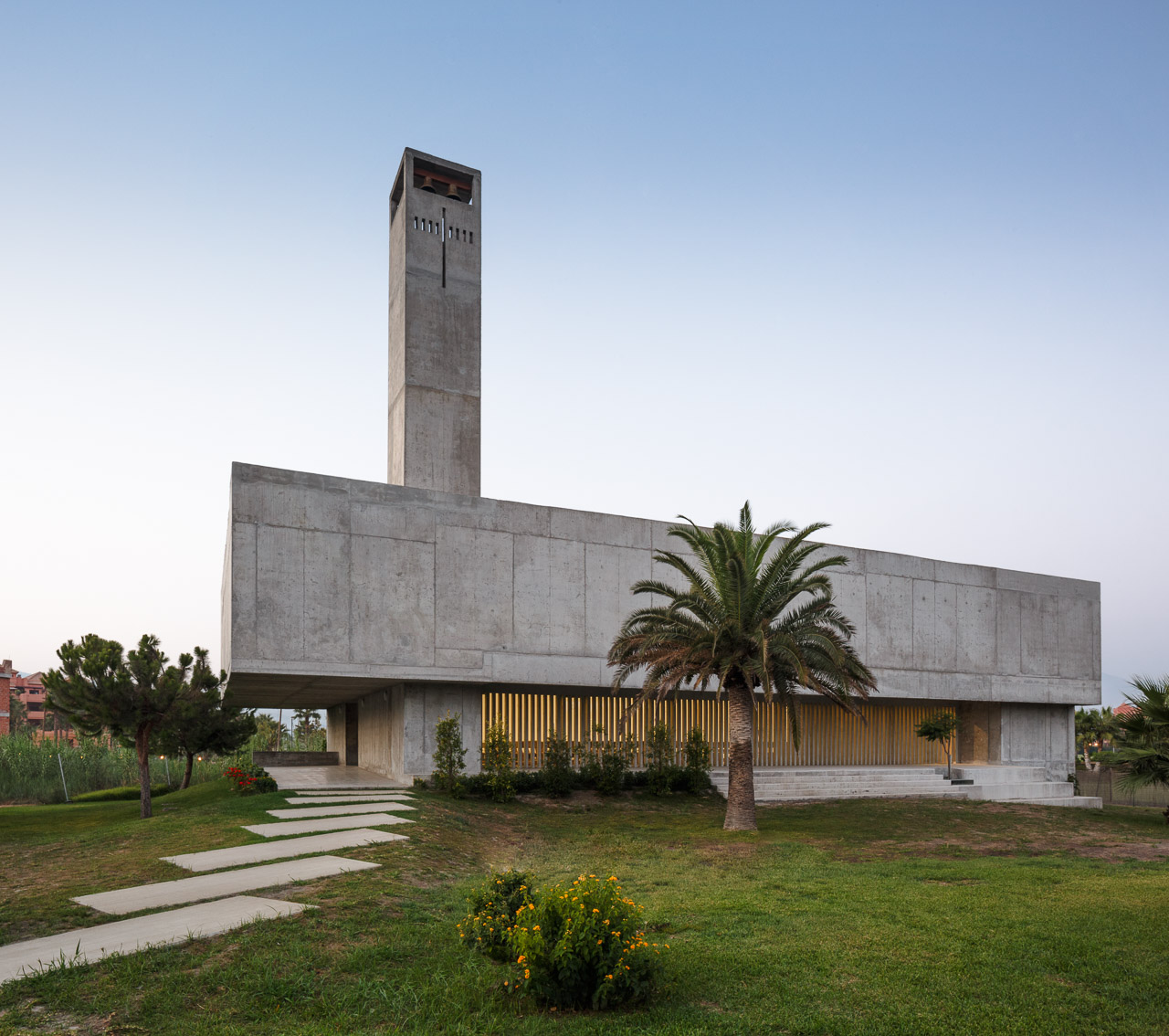
Consecrated in 2016 by the then Archbishop of Granada, Mons. Javier Martínez, the Church of Santa Josefina Bakhita stands with astonishing architectural purity. Its minimalist design, with clean white lines, constantly plays with the natural light that floods its interior, creating an atmosphere of serene introspection. This luminosity contrasts fascinatingly with the surroundings: modern urbanizations and the pristine green of the golf course, establishing a dialogue between the earthly and the spiritual.
The church's location is, in itself, a chapter of history. Situated on Calle Rector Lorenzo Morillas Cuevas, 14, it shares a wall with Villa Astrida, the famous summer palace that was the home of King Baudouin of Belgium and the place of his death in 1993. This proximity to such an emblematic place gives the church a particular historical resonance, anchoring it even more in Motril's heritage and making it a point of reference for those visiting Villa Astrida in Motril.
From its exterior, the church invites tranquility. Its simple facade, devoid of superfluous ornaments, focuses attention on the essence of its purpose. Upon crossing its doors, light becomes a cathedral-like element, guiding the gaze towards the altar with a sober elegance rarely found in contemporary architecture. It is a space designed for contemplation, where every ray of sunshine seems to bless the silence.
The Moving Story of the Saint and the Connection with Motril: A Symbol of Freedom
The name of this church was not chosen at random; it holds a deep symbolic meaning and a direct link to one of the most painful and complex realities of our coast: migration. Saint Josephine Bakhita (1869-1947) is a figure whose life, tragic and redemptive in equal measure, resonates with unusual force in Motril.
Born in Darfur (Sudan), as a child she was kidnapped by slave traders. Sold and resold up to five times, she suffered the unspeakable cruelties of slavery, including the 114 scars that marked her body as a brutal tattoo of belonging. Finally, she found freedom in Italy, where she became a Canossian nun and dedicated her life to God and service. Beatified in 1992 and canonized in 2000, Saint Josephine Bakhita has become a universal symbol of liberation from slavery and human dignity in the face of oppression.
The Archbishopric of Granada, by dedicating this temple to her, sent a powerful message. The church of Playa Granada is, from its conception, a constant reminder and a place of prayer for the hundreds of migrants who, every year, throw themselves into the sea in search of a future, arriving in dinghies on the coasts of Motril. Her story becomes an echo of the pain and hope of those who today cross the Mediterranean in extreme circumstances, seeking the same dignity and freedom that Josephine achieved in life.
> "The story of Saint Josephine Bakhita is not a distant tale from the past; it is a mirror of the humanity that daily strikes our shores. Her church in Playa Granada is a cry of hope and a constant reminder that freedom and dignity are inalienable rights that we must defend, especially for those who arrive seeking refuge."
The temple stands as a beacon of empathy in a tourist landscape. Visiting it is connecting with the most human and supportive facet of the Tropical Coast, offering a space for personal reflection on the great challenges of our time.
The Art that Breathes: The Work of Ramiro Megías
Inside this minimalist sanctuary, a work of art stands with an overwhelming presence and a profound emotional charge: the life-size sculpture of Saint Josephine Bakhita. This creation is the work of the prestigious Granada sculptor Ramiro Megías, an academic with an impressive artistic legacy (author of famous works such as "John Paul II" in Granada or the "Living Fountain" in Lanjarón).
Megías's sculpture is not merely a representation, but an embodiment of the saint's pain, strength, and faith. The piece, made of clay with a technique that allows every fold and texture to be perceived, moves with its realism and the expression on Bakhita's face. Her features, marked by suffering but also by the serenity of one who has found peace, invite contemplation. The 114 scars, far from being an anecdotal detail, are integrated into the work as a silent testimony to her ordeal, transformed by the artist's hand into the universal language of overcome pain.
Ramiro Megías, in a gesture of artistic and spiritual generosity, donated this imposing work to the temple. The sculpture was formally blessed in a moving Eucharist on July 21, 2018, becoming the visual and spiritual heart of the church, an anchor point for reflection and prayer for those who suffer. Its presence transforms the space, adding a layer of human and artistic depth that complements the architectural purity of the place.
A Sanctuary for Early Music: The Cultural Epicenter of the Coast
Beyond its spiritual and social role, the Church of Santa Josefina Bakhita has consolidated its position as a leading cultural reference on the Tropical Coast, especially in the field of classical and early music. Its exceptional acoustics have made it the official venue for the acclaimed "Baudouin and Fabiola" Early Music Festival.
Held every August, this festival, which recently reached its II edition, is a brilliant initiative organized by Juventudes Musicales de Motril. It was born with a dual purpose: to commemorate the 50th anniversary of this prestigious Motril musical institution and to honor the memory of the Belgian monarchs, King Baudouin and Queen Fabiola, so closely linked to Playa Granada.
Summer nights in the church are filled with chamber, baroque, and Renaissance notes, performed by top-level groups. Talents such as the Ventus Nazaríes Ensemble or the Mediterranean Chamber Orchestra have paraded by its altar and under the magnificent vault of its nave, offering the public unforgettable sound experiences. The purity of the music, the mysticism of the surroundings, and the interpretive quality merge in an atmosphere that transcends mere listening, becoming a true sensory journey.
> "The acoustics of the Church of Santa Josefina Bakhita are a gift. Listening to a Bach piece or a Renaissance motet here is feeling the music vibrate in the soul, an intimate dialogue between art and the divine that few halls manage to contain with such majesty."
This festival not only enriches the cultural offerings of the Tropical Coast but also vindicates the role of art as a bridge between different eras and sensibilities, offering visitors and locals a high-level cultural alternative in a unique setting like Playa Granada. It is, without a doubt, an unmissable event for lovers of good music.
Practical Information and Conclusion: Your Next Visit to Playa Granada
The Church of Santa Josefina Bakhita is not just a point on the map; it is an experience that perfectly complements any visit to the Tropical Coast of Granada. Its simplicity, its art, its history, and its cultural reverberation make it a place that invites reflection and personal enrichment.
Address: Calle Rector Lorenzo Morillas Cuevas, 14, 18600 Playa Granada, Motril, Granada.
How to fit this visit into your day in Playa Granada:
You can start the morning enjoying a walk along the beach, practicing some water sports, or even playing golf on the adjacent courses. At noon, a well-deserved paella or a sardine skewer at the beach bars in the area is almost a must. In the afternoon, before sunset, a visit to the Church of Santa Josefina Bakhita will offer you a moment of calm and beauty, a spiritual pause that contrasts with the vitality of the coast. If your visit coincides with August, do not miss the opportunity to enjoy one of the concerts of the "Baudouin and Fabiola" Early Music Festival.
The Church of Santa Josefina Bakhita is a reminder that the Tropical Coast is much more than sun and sand. It is a place where history, art, faith, and solidarity intertwine to offer a complete and enriching travel experience.
From the Playa Granada Team at Granadaplaya.com, we strongly encourage you to discover this unique corner, to let yourself be captivated by the story of Saint Josephine Bakhita, the beauty of Ramiro Megías's sculpture, and the magic of its music. And, of course, we invite you to explore all the secrets of the Tropical Coast through our accommodations. [See available apartments →]
¿Te ha gustado este artículo?
Suscríbete para recibir artículos como este directamente en tu email. Sin spam, solo contenido de calidad.
Puedes cancelar en cualquier momento.